
Secret Dreams and Forbidden Fire At 40
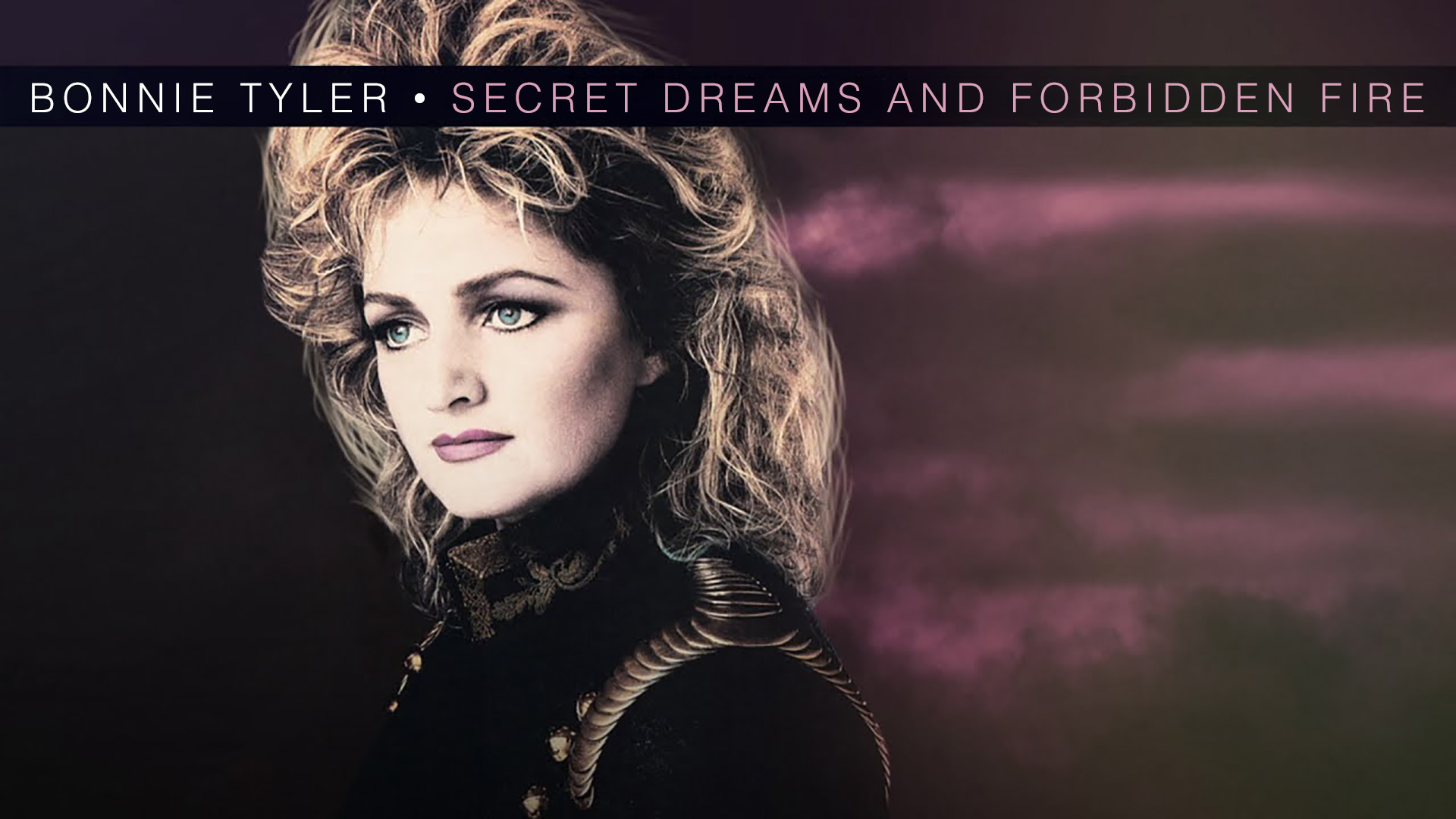
Today marks exactly 40 years since Secret Dreams and Forbidden Fire was unleashed in the United States. Released on 7 April 1986, via Columbia Records (followed by Japan on April 21 and Europe in early May), the album remains a towering monument to the Wagnerian Rock era.
The record served as Bonnie’s second and final full-album collaboration with legendary producer and songwriter Jim Steinman. Returning to the Power Station in New York – the same studio where they captured the lightning of “Total Eclipse of the Heart” – the duo aimed to push the boundaries of epic production even further.
“I’ve been planning this album since I finished the promotion work on Faster Than the Speed of Night,” Bonnie told Tracks magazine. “I’d been getting songs together for about a year, and I asked Jim if he could produce the album.” It took a while for Jim to get involved due to other work commitments, but recordings finally commenced in 1985. “I like working with Jim, he brings out the best in me,” Bonnie continued.
The Secret Dreams sessions began at the Power Station studio in New York with the Bryan Adams song “No Way to Treat a Lady”, co-written by Jim Vallance. “I did one song of his on the last album,” Bonnie said. “He gave this one to me and came along to the studio to have a listen, and he told me he loved the way we’d done it.” The song was also recorded by Bonnie Raitt for her album Nine Lives.
Much like its predecessor, Faster Than the Speed of Night, this album leaned into high-concept covers. A notable inclusion was “Band of Gold”, a song trending in the mid-80s with a similar version also released by Belinda Carlisle. “It sounds nothing like the original,” Bonnie said. “We’ve got a load of synthesisers on it, and a drum machine. Even though we used Bruce Springsteen’s drummer Max Weinberg on all the tracks, a drum machine seemed to work better on Band of Gold.”
To this day, Secret Dreams and Forbidden Fire stands as Bonnie’s most-streamed studio album. This is largely driven by the juggernaut closing track, “Holding Out for a Hero”. While Faster Than the Speed of Night is a close contender, its streaming numbers are split; the single edit of “Total Eclipse” is housed on a compilation rather than the original studio album.
The album is home to several Steinman originals that have become cult favourites, such as “Ravishing” and “Rebel Without a Clue”. Interestingly, these tracks don’t see the streaming volume their fan-favourite status might suggest. This is primarily due to record labels frequently omitting them from best-of collections in favour of earlier CBS-era tracks like “Straight from the Heart” or “Tears”. Finding these epic songs on a compilation is a rare treat for collectors.
While “Hero” was the commercial titan (originally released in early 1984), the album’s true campaign began with the Todd Rundgren duet, “Loving You’s a Dirty Job (But Someone’s Gotta Do It)”, in November 1985. This sprawling, theatrical masterpiece remains one of Bonnie’s personal favourites.
Another standout is the Desmond Child-penned “If You Were a Woman (And I Was a Man)”. While it conquered charts in France and Poland, its underperformance in the US led Child to rework the melody for Bon Jovi’s “You Give Love a Bad Name”. The song later found a third life via Ava Max’s “Kings & Queens”. Recently, critics have re-appraised the track as a pioneering feminist anthem, exploring themes of androgyny and gender identity.
The music video for “If You Were a Woman (And I Was a Man)” was filmed on a large budget at Christ Church in Spitafields, in the Whitechapel area of central London. The extended edit stars Mary Morris as an older version of Bonnie’s character. She gives a monologue about her earlier life as an entertainer at The Dive, a club and place of refuge from an ongoing war in the fictional city of Obsidian. The video employs different colour techniques, including a spectacular sequence in the “room of black and white”, where a curtain drop reveals bright colours. Jim Steinman was at the heart of this video, which he directed alongside Stuart Orme.
The video for “Loving You’s a Dirty Job” was filmed with a smaller cast at a movie theater, with Welsh actor Hywel Bennett stepping in to lip sync Todd Rundgren’s vocal lines as he was unavailable at the time of filming. The song features the album’s title in the lyrics: “Would you follow your secret dreams and forbidden fire?” The title is also displayed above the front door, hinting that the entire song – or album – is in fact a stage show or a play.
“Loving You’s a Dirty Job” was directed by Tim Pope, whose major collaborations included videos by The Cure, Talk Talk, and the Psychedelic Furs. “We got four different video companies interested in it,” Bonnie told Tracks magazine. Tim Pope’s ideas stood out most; Bonnie was sold after seeing his hand-drawn sketches planning out every sequence. He also created the huge mural of Bonnie and Hywel’s faces which appears later in the video. It was later entered into a raffle on the TV show Saturday Superstore. Tim Pope was also the only prospective director to suggest a stand-in actor to lip sync to Todd Rundgren’s vocals; all other production companies had suggested using a silhouette.
Jim’s intentional symphonic architecture defines the album, as he meticulously repurposed motifs to create a cohesive, career-spanning narrative. This cross-pollination transforms individual tracks into movements of a larger work. “Ravishing” was developed in tandem with “Hulk Hogan’s Theme” from The Wrestling Album; both tracks share the same aggressive, industrial percussion. Bonnie even remarked on the recording of those additional textures in a Twitter Listening Party years back:
One day of recording this song, Jim Steinman called about 30 people off the streets in New York to all bang metal objects on a huge metal sheet in time to the chants of “HULK HULK HULK” 😂 #SecretDreamsListening
— Bonnie Tyler (@BonnieTOfficial) July 15, 2020
Likewise, “Holding Out for a Hero” reclaims the high-octane piano introduction from Jim’s solo track “Stark Raving Love”, from his 1981 solo project Bad for Good. Even “Total Eclipse of the Heart” was built upon melodic seeds first planted in his score for the film A Small Circle of Friends (1980).
The track listing for Secret Dreams and Forbidden Fire differs on each release format. The complete 10-track version is only available on cassette, while the CD had 9 tracks, and the LP version just 8. “Under Suspicion” was released exclusively on the cassette edition, and due to the emergence of digital music consumption in subsequent decades, that track has now drifted into rarity status. It was written by Bonnie’s keyboard player and MD at the time, Peter Oxendale, alongside Bonnie and her brother Paul. This trio wrote several of Bonnie’s b-sides in the mid to late 80s, and “Under Suspicion” was the only one to make it onto an album and to receive the Jim Steinman production treatment.
“Before This Night Is Through” can only be found on the cassette edition, and the CD – and now streaming – edition. It was written by Italian musician Beppe Cantarelli, and American lyricist Adrienne Anderson. It was rumoured at the time that Tina Turner had earmarked the song but chose not to record it, so the opportunity came for Bonnie to try her hand at it in the studio. The song has been frequently re-recorded, often under the Italian title, “Sei un buco all’anima”, by Beppe Cantarelli and some of his friends and collaborators for an ongoing recording project since the early 90s. One standout version is by Aida Cooper, whose vocal sounds remarkably similar to Tina Turner.
Other b-sides from this period include “It’s Not Enough” and “I Do It for You”, which can be found on the other side of some of the singles from Secret Dreams. Bonnie also concurrently recorded for other projects around this time, including a highly popular song in Brazil titled “Sem Limites pra Sonhar (Reaching for the Infinite Heart)” in duet with Fabio Jr., and the song “Prizefighters”, a duet with Chris Thompson from Steve Hackett’s record Feedback ’86, which finally released in 2000. Bonnie’s spectacular vocal on “It’s Not Easy” can be found on The Anti-Heroin Project’s album, and it recently made a welcome return to streaming platforms.
Other rarities from this period include the two remixes of “Band of Gold”, which debuted on CD in 2017 as part of the Remixes and Rarities double-disc.
At the time of its release, Secret Dreams was often misunderstood. Critics at the time balked at the extended song lengths and Steinman’s signature heavy dynamics. However, 40 years later, the album is celebrated for exactly those reasons: its uncompromising scale, its emotional intensity, and its status as a definitive peak in Bonnie’s recording career, which now spans eighteen albums.